Next were natural gas combustion turbines, with 22 projects, and natural gas internal combustion engines, with 21.
Onshore wind had nine projects.
Combined-cycle natural gas, despite having massive amounts of announced capacity in development, had just three projects that went online. The high tide of new gas plants won’t arrive for another few years.
Capacity by Technology
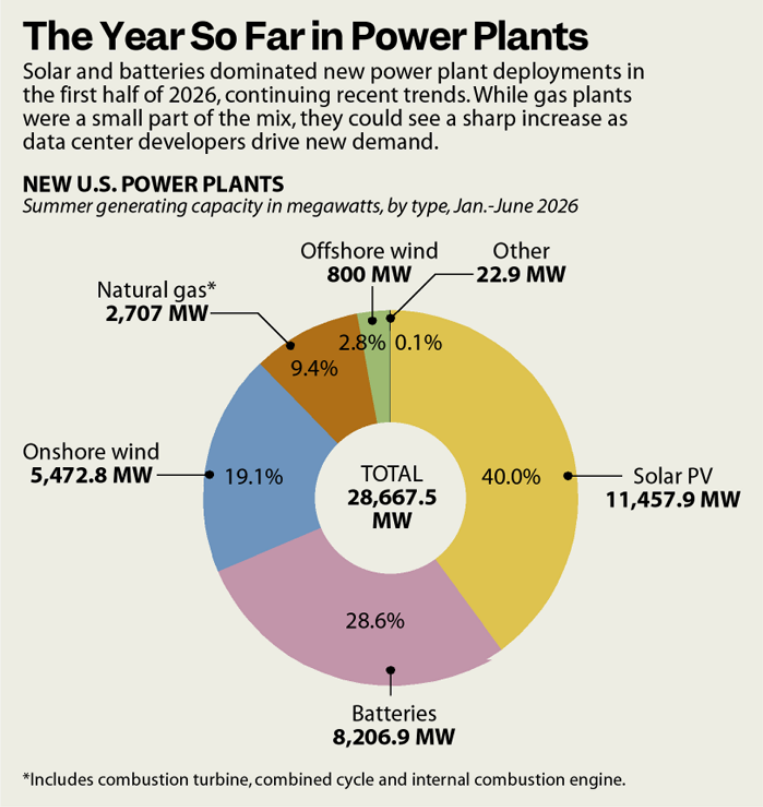
In terms of generating capacity, utility-scale solar led with 11,458 megawatts, followed by batteries at 8,207 megawatts, and then onshore wind — boosted largely by the SunZia projects — at 5,473 megawatts.
The three largest types of natural gas plants combined added 2,707 megawatts of new capacity.
Small-scale solar, including rooftop solar, is not part of this database.
One important caveat when comparing generating capacity across technologies: solar produces no power at night, and many gas plants run only a few days or weeks per year to handle peak demand.
What the Numbers Mean
Eric Gimon, a senior fellow at Energy Innovation, a San Francisco-based think tank, noted that the bulk of new projects are small and mid-size utility-scale solar installations — not attention-grabbing individually, but appearing almost everywhere across the country. Many are paired with batteries.
“These kinds of smaller-size projects are just easier to build, and the site possibilities are much more diverse and easy to find,” Gimon said.
Where the Plants Were Built
Three states account for roughly half of the country’s new generating capacity: Texas, New Mexico, and Arizona.
Texas led the nation, with a power mix that leaned more heavily on batteries and gas than other states. The top category in Texas was batteries at 3,067 megawatts, followed by utility-scale solar at 2,311 megawatts, and then natural gas combustion turbines and internal combustion engines combined at 1,154 megawatts.