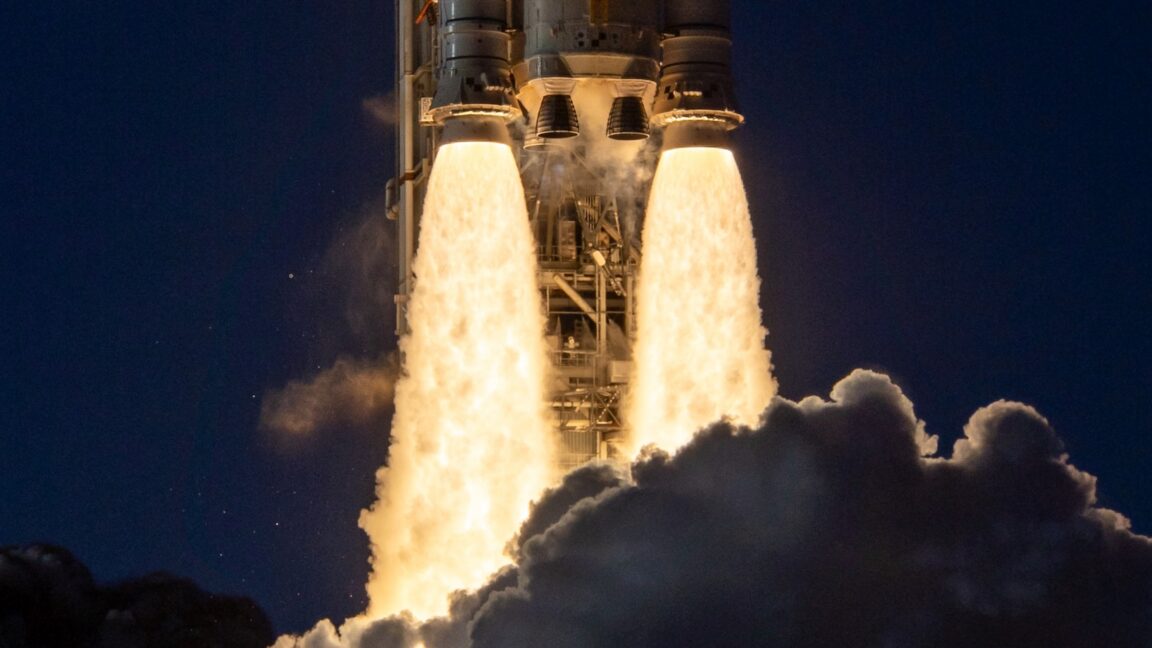
Welcome to Edition 9.18 of the Rocket Report! Blue Origin packed a lot of news into one afternoon Thursday with the reveal of a new kick stage for the New Glenn rocket, a new rocket engine design, and the minor and widely expected delay for New Glenn’s return-to-flight mission from December until January. The reconstruction of Blue Origin’s wrecked launch pad at Cape Canaveral, Florida, continues apace after a catastrophic explosion nearly six months ago. There’s a lot of pent-up demand from NASA, Amazon, and the Space Force for Blue Origin to get New Glenn back in action.
Small Lift
SpaceX vets work on water-fed propulsion. Three brothers who worked at SpaceX in the Falcon 9 era are now building satellites that run on water, a potentially harvestable resource on the Moon and found all over the Solar System, Ars reports. In late 2022, the three Carlisle brothers founded Argo Space to build infrastructure in space. Their vision was not just in-space transportation but also removing the need to use propellants from Earth to move around the heavens. Argo Space’s satellites will use water not only as a propellant, but also as a coolant and radiation shield.
How does this work? Argo Space flew its first mission in July, but the spacecraft failed after one of its solar arrays didn’t deploy, and there wasn’t enough time to test the propulsion system. Two more missions are on Argo Space’s schedule for 2027 to demonstrate the company’s water-based thrusters. The propulsion system is basically a small rocket that uses hydrogen and oxygen as propellants. However, instead of launching with separate tanks of liquid hydrogen and liquid oxygen, the satellite carries a reservoir of liquid water. In space, the vehicle uses solar power to split water into hydrogen and oxygen gases and burns them to generate thrust.
JAXA backs small satellite launcher. Japanese launcher startup Interstellar Technologies has secured the backing of the Japan Aerospace Exploration Agency (JAXA) for its Zero rocket program, Aviation Week & Space Technology reports. The company said JAXA selected it for its Acceleration of Commercial Rocket Launch Demonstration program under the Space Strategic Fund. The government-funded program supports development and flight demonstrations of private launch companies with grants of up to $76 million per company, with the goal of fostering a growing commercial launch industry in Japan. Interstellar previously raised more than $250 million, with roughly equivalent funds from government and private capital.
Zeroing in … Interstellar is using the money to complete development of its Zero rocket, a two-stage launcher designed to carry up to 1 metric ton (2,200 pounds) of payload to low-Earth orbit. “We have achieved critical technical milestones, including Japan’s first successful firing test of an orbital-class methane engine,” said Satoshi Nakayama, director of the board and president of Interstellar. “We have now reached the stage where we must swiftly turn these proven development results into operational commercial services.” The most recent update from Interstellar indicated a first launch of Zero in 2027.
Medium Lift
Launch demand outpacing supply. A new report from analytics firm Quilty Space confirms that, outside of China, the world faces a significant shortage of rockets over the next five years, Ars reports. The firm estimates that between now and 2030, there will be a shortfall of about 150 launches compared to demand from satellite operators and civil space agencies. If demand from the US military is added in — and SpaceX does not extend the Falcon 9 and Falcon Heavy program to accommodate increased national security needs — the shortage could be doubled.
Worse than we thought … “What we wanted to get at is to understand how severe this launch crisis is and when will it be resolved,” said Caleb Henry, director of research at Quilty Space. “What we learned is that the launch crisis is more severe than we thought and that it will not go away this decade for sure, and it might not abate until sometime late in the 2030s.” Why is this happening? Quilty puts the blame on several factors: the war in Ukraine taking Russian rockets off the Western market; Amazon Leo demand; developmental delays in a new generation of rockets, from New Glenn and Vulcan to Neutron, Terran R, and Nova; and more recently, the retirement of the Falcon 9 as a rocket for commercial service.
China continues launching mega-constellation. Another 18 satellites for China’s SpaceSail Internet network launched Tuesday (Monday, US time) from a spaceport in the country’s northwestern desert. The mission marked the second launch — and first operational flight — of the Kinetica 2 rocket developed by a Chinese startup known as CAS Space. The SpaceSail constellation, also known as Qianfan, now consists of some 275 flat-panel satellites from a series of launches that began in August 2024. The network’s first phase will number 1,296 satellites.
A mini-Falcon Heavy … The Kinetica 2 is an interesting launch vehicle, with three side-by-side boosters arranged in a manner similar to SpaceX’s Falcon Heavy. But the Kinetica 2 is a much smaller rocket, with three kerosene-fueled engines on each booster instead of nine. Its lift performance to low-Earth orbit is about 12 metric tons (26,000 pounds). CAS Space plans to eventually recover and reuse the Kinetica 2 boosters.
India launches strategic navigation satellite. A Geosynchronous Satellite Launch Vehicle (GSLV) rocket launched on October 30 with a satellite to restore India’s regional navigation system, NDTV reports. The NVS-03 satellite is the third spacecraft in India’s second-generation navigation network. Some of the fleet’s older satellites suffered from atomic clock failures, rendering them partially or totally unusable. NVS-03 carries multiple clocks of different designs in an attempt to overcome the system’s reliability problems.
A “naughty boy” … India’s medium-lift GSLV has now launched 20 times since debuting in 2001. The rocket doesn’t fly as often as India’s smaller launcher, the PSLV, and hasn’t always performed well when it has. Six of the 20 flights ended in total or partial failures, but most of the mishaps occurred early in the rocket’s history. GSLV’s track record earned it the title “naughty boy” from Indian space officials. The most recent launch was a different story. The head of India’s space agency, V. Narayanan, declared that the GSLV’s recent flight was the “most precise launch of any rocket in the world.” We’re not sure what metric Narayanan used to make that claim, but the launch was, indeed, a success.
Heavy Lift
China reveals roadmap to lunar landing. Chinese space officials confirmed that the Asian nation plans to land its astronauts on the Moon within three years, Ars reports. At the Seventh Manned Spaceflight Conference in Beijing, officials including Wang Xiang, chief designer for the lunar exploration program, laid out a concrete timeline targeting a crewed lunar landing before 2030, putting China on a direct collision course with NASA’s own Artemis program goals for returning humans to the Moon’s surface.