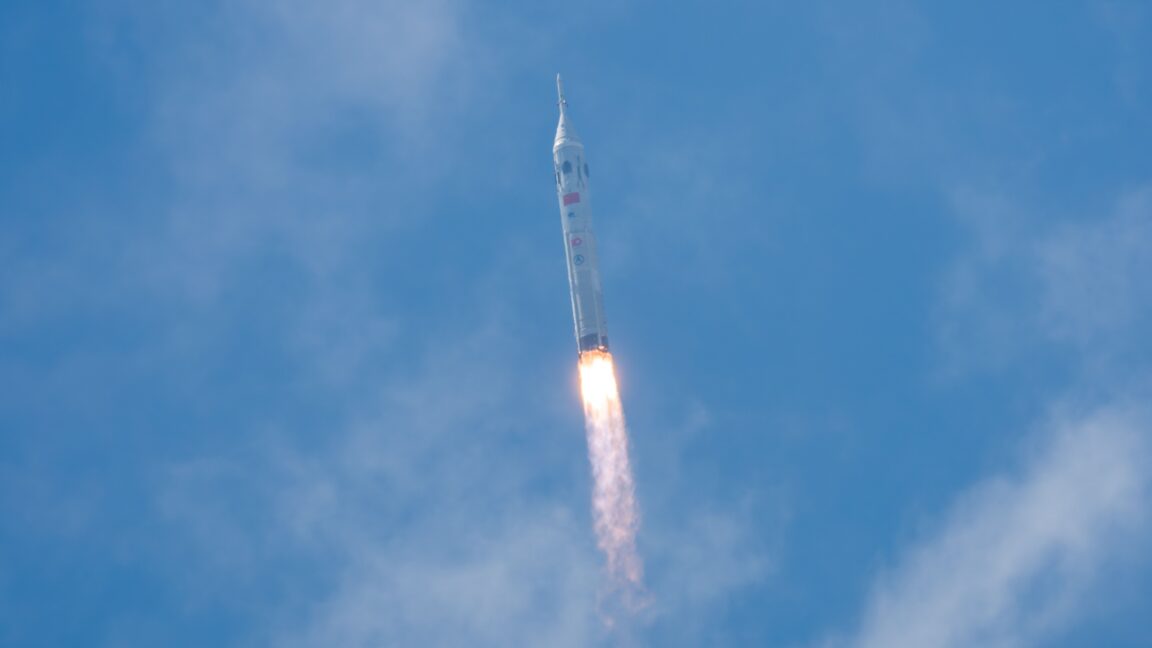
“NASA desperately needs SpaceX, and SpaceX knows it, and Elon knows it.”
 Credit: Aurich Lawson | Getty Images
For nearly a quarter of a century, Elon Musk and his essential partner at SpaceX, Gwynne Shotwell, viewed the United States government as El Dorado, the mythical city of gold.
Like machete-wielding treasure hunters, Musk and Shotwell hacked through a tangled jungle filled with lurking carnivores such as Boeing and Lockheed Martin, as well as bean counters and regulators. Over time, against long odds, the pair cleared a path for SpaceX to contracts at NASA and the US military. They sued when things did not go their way. They hollered about unfair playing fields. Most importantly, they delivered quality space products to the US government for less.
And so, after a while, SpaceX found El Dorado and a city of contracts.
Then they started winning everything. So much so that the relationship between the customer and contractor began to change. Slowly at first, but ever more quickly, SpaceX went from needing the US government as an indispensable customer to becoming an indispensable contractor for the nation.
The pendulum has swung so far now that SpaceX seems increasingly disinterested in the US government for most contracts outside of data services, such as Starshield for military communications and observations.
“I guess I am still in denial that there is a divorce pending,” said Lori Garver, a deputy NASA administrator during the Obama White House years who was instrumental in expanding the agency’s use of commercial contracts with companies like SpaceX. “I literally cannot wrap my head around a future yet where SpaceX stops flying Dragon and Falcon. Not yet.”
But the signs point to at least a partial breakup. Consider the following data points:
- SpaceX has told NASA it will stop flying Crew Dragon, the space agency’s only reliable astronaut transportation to the International Space Station, by or before 2030. Shotwell said in September that NASA should rely instead on Boeing for astronaut transportation. “We’re just gonna let them have some business,” she said of Boeing. “They should fly their capsule. The government paid a lot of money for that.” As a result, NASA is investing more in Boeing.
- Ars reported in October that SpaceX had stopped selling commercial launches on the Falcon 9 rocket for missions after the year 2028.
- SpaceX may also still stop flying Falcon 9 for NASA missions. In late October, during a meeting of NASA’s Safety Advisory Panel, Kent Rominger said if the US Deorbit Vehicle (a modified Dragon spacecraft) launches to the International Space Station after 2030, “it may require” a rocket other than the Falcon 9.
- Politico reported last week that SpaceX told the US Space Force it would not bid on three new launch contracts in the late 2020s that would have gone above and beyond its existing commitments to the US military.
- SpaceX previously provided “Rough Order of Magnitude” estimates, or ROMs, for launch costs to US companies building small landers for NASA’s Moon Base as part of the Commercial Lunar Payload Services program. But according to three sources, SpaceX recently told these lunar companies they will not provide launch services.
A Shift in the Balance of Power
To be clear, SpaceX is still fulfilling its existing contracts with NASA, the US Space Force, and other government entities. And it continues to do so at a lower cost and generally higher level of reliability than pretty much anyone else.
But the company is no longer signing many large new contracts for spaceflight services, at least in the traditional launch and in-space flight domains. The shift comes after 15 years in which the US government has grown accustomed to lower costs and rapid innovation that has revitalized the nation’s access to space.
For SpaceX and its shareholders, as shocking as it may seem for a US company to leave billions of dollars on the table in government contracts, this may be the right decision. SpaceX sees the vast bulk of its future revenue coming from artificial intelligence. However, SpaceX’s retreat from the public square comes as both NASA and the Space Force confront growing challenges from a rising space program in China and an aging but still dangerous Russia in space.
So what does it mean if the halcyon days of SpaceX riding to the rescue for America in space — such as in the saga of Butch Wilmore and Suni Williams — seem to be ending?
How We Got Here
In the early days, Musk and Shotwell sought revenue from various sources as SpaceX developed the scrappy Falcon 1 rocket. But it was NASA that stepped in at two crucial moments in the company’s first decade.
The first came in 2006, with a $278 million award to develop a cargo delivery spacecraft for the International Space Station. It helped SpaceX expand rapidly when it was struggling to develop the Falcon 1 rocket. An even more consequential award arrived in December 2008: $1.6 billion for a dozen Dragon cargo flights to the space station. The funding arrived as SpaceX struggled to meet payroll. Both Musk and Shotwell have said this award probably saved SpaceX from bankruptcy.
 NASA Administrator Michael Griffin, left, meets with CEO of SpaceX Elon Musk, right, on April 20, 2005, at NASA Headquarters in Washington. Credit: NASA/Rene
Those early investments by NASA gave SpaceX the runway it needed to build the reliable launch business that would eventually make it the dominant force in American spaceflight — and, ironically, the leverage to walk away from the agency that helped create it.