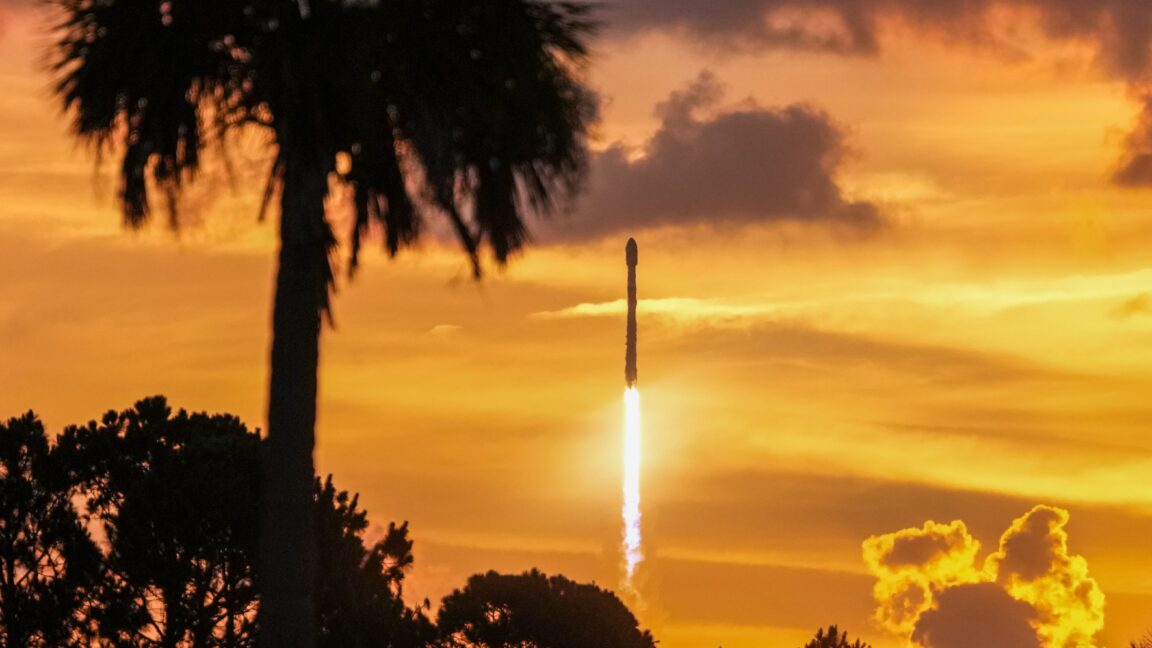
Welcome to Edition 8.44 of the Rocket Report! The news this week is decidedly weighted in favor of heavy-lift rockets, largely due to the fallout from last Thursday’s explosion of Blue Origin’s New Glenn on its launch pad in Florida. Blue Origin aims to resume launches at the badly damaged launch facility by the end of the year, but there’s good reason to be skeptical of this timeline. With New Glenn grounded, will Blue Origin founder Jeff Bezos approach Elon Musk’s SpaceX to launch his Blue Moon lander to the lunar south pole? It sure sounds like NASA is pushing for that.
Small-Lift Rockets
Spaceport development moves forward in Canada. There’s been a lot of talk about the Canadian government’s recent commitment to invest in a sovereign launch capability. There was the announcement last year of a federal budget of 182.6 million Canadian dollars ($131 million) over three years to establish a sovereign launch program. In March, the government said it would lease a dedicated launch pad at a commercially developed spaceport in Nova Scotia for national defense purposes, committing 200 million Canadian dollars ($144 million) to the deal. The agreement is a boon for Maritime Launch Services, which is developing Spaceport Nova Scotia after years of slow progress at the coastal site, SpaceQ reports.
Keeping civil… The initial phases of development focus on civil works, with road construction, utility connections, and construction of a “central hub” that will connect key commodities to the spaceport’s launch pads. Design work on the spaceport’s first launch vehicle integration facility should be complete in July, with construction tendering to start before the end of August, according to Stephen Matier, the CEO of Maritime Launch Services.
Canada is spending serious money on developing its own access to space, with federal grants awarded to three Canadian launch startups, and now an agreement to bankroll construction at Spaceport Nova Scotia. But Canada has a long path ahead. The nation has little experience in the launch sector, and it’s hard not to wonder if there’s any significant private investment that will follow the government’s sizable financial commitment in this area.
Medium-Lift Rockets
A new Chinese rocket designed for reuse. The race to field China’s first reusable launch vehicle is far less predictable than a similar competition that played out in the United States a decade ago. A new rocket entered the field Monday with the first successful launch of China’s Long March 12B rocket, Ars reports. Engineers did not attempt to recover the Long March 12B’s booster stage, but the rocket flew with grid fins and landing legs, and Chinese officials touted plans to eventually land and reuse the first stage. The Long March 12B’s debut follows China’s first two attempts to recover an orbital-class booster with the Zhuque-3 and Long March 12A rockets in December. Neither landed successfully, but both rockets reached orbit.
A new rocket (almost) every month… Another new Chinese rocket, the partially reusable Tianlong-3 developed by a company named Space Pioneer, failed on its first launch in April. Several more new rockets designed for booster reuse could fly later this year. The Long March 12B is the largest of China’s new crop of would-be reusable rockets. It was developed by China Commercial Rocket Co. Ltd., or CACL, an opaque business venture set up by China’s sprawling state-owned aerospace enterprise. According to Chinese state media reports, engineers designed and developed the Long March 12B in just 21 months. If the claim is true, it would be a remarkably fast timeline to progress from a clean sheet to an orbital flight.
Impulse Space’s wallet just got a lot heavier. On Tuesday, Impulse Space, a company dedicated to improving space mobility, announced it has raised $500 million in Series D funding, Ars reports. Since it was founded five years ago by SpaceX veteran Tom Mueller, the company has now raised more than $1 billion. “Timing is everything,” Mueller said in an interview about the new round of funding. By this, he means the company has found its way into many markets. The company has already flown three missions with a small spacecraft, Mira, which was first launched in 2023 with a novel propulsion system powered by non-toxic propellants, nitrous oxide and ethane.
Lots to do… Impulse has more customers lined up. After the company announced its much larger “Helios” kick stage, demand from commercial customers was higher than anticipated. The US Space Force has become increasingly interested in satellite mobility, and now Impulse Space also believes it can provide landing services in the “1-ton-class” to NASA for its new Moon Base initiative.
Amazon is running out of Atlas Vs. United Launch Alliance overcame adverse weather conditions to launch a batch of Amazon Leo’s broadband internet satellites on its Atlas V rocket from Cape Canaveral Space Force Station on May 29, Spaceflight Now reports. This was the seventh batch of production satellites that ULA launched on behalf of Amazon and the penultimate mission for the tech giant using an Atlas V rocket. There were 29 satellites aboard the Atlas V.
One more to go… Amazon purchased a total of 47 launches from ULA: 38 Vulcan rockets and nine Atlas V rockets. Amazon has now used eight of those Atlas Vs and none of the Vulcans, which are grounded after a solid rocket booster anomaly on a US Space Force mission in February. In all, Amazon purchased more than 100 rockets to launch more than 3,200 satellites for its first-generation constellation. The two rockets Amazon intends to use most - ULA’s Vulcan and Blue Origin’s New Glenn - are currently unavailable.
Heavy-Lift Rockets
Blue Origin strives for a quick comeback. The chief executive of Blue Origin, whose large New Glenn rocket exploded spectacularly less than a week ago at the company’s launch site in Florida, vowed Monday night that the company would launch again before the end of 2026, Ars reports. Writing on X, Blue Origin’s Dave Limp said the company had been able to complete a preliminary survey of the LC-36A launch site. “Now that we’ve had access to the pad and integration facility, we can share a bit of good news,” Limp said. “The propellant farm, oxygen, liquid hydrogen, and LNG tanks are all in good shape. This is good luck because these are very long lead items. The water tower is also good.”
Taking inventory… Limp also confirmed that the company would press ahead with a rebuild of the LC-36A site, which is designed for the 7×2 variant of the New Glenn rocket. One option had been to focus on building a larger pad next door, at LC-36B, capable of supporting the larger 9×4 variant of the rocket - the nine and four referring respectively to the number of engines in the first and second stage of the rocket.