
Ars Technica is here to help with a guide to the medium-lift space race.
 Nova rocket’s upper stage, flight article, during a fit test. Credit: Stoke Space
It has been 13 years since the debut of a new medium-lift rocket in the United States, the Antares vehicle developed by Orbital Sciences Corporation.
The initial 100-series variant of the Antares rocket was kind of a hot mess. The rocket used old Soviet engines built during the era when Apollo astronauts were landing on the Moon. Decades later, in the 1990s, Aerojet acquired the engines and refurbished them for a rocket that would launch in the 2010s. Predictably, on the fifth launch of an Antares rocket in 2014, it exploded.
The Antares vehicle is the last of a dying breed of medium-lift rockets—defined as having a lift capacity of 2 to 20 metric tons—in the United States. Nearly a decade and a half later there is a new generation of medium-lift vehicles coming online, and they are starkly different from Antares, which had not just Russian engines but a core stage manufactured in Ukraine.
Four forthcoming rockets all have engines built by the rocket’s manufacturer in the United States. Each of these companies has taken various lessons from SpaceX’s successful Falcon 9 rocket, arguably the most important of which is to build as much of one’s rocket, and particularly the engines, in-house as possible to control timelines and costs.
Now, with SpaceX pulling the Falcon 9 rocket from the commercial market as soon as 2028, the “race” to bring new medium-lift capacity into service is for more than bragging rights. There are fortunes to be made, and commercial space startups to be saved.
Satellite operators legitimately don’t know who to book launches with in the 2027 to 2030 timeframe because of uncertainty over which rockets will be available. The Falcon 9 is no longer for sale. The larger Vulcan and New Glenn rockets have stacked manifests and are expensive for small- and medium-sized satellites. And no one really knows which new medium-lift vehicles will be ready and capable of scaling up their launch cadence.
With all of this in mind, the following is a guide to the medium-lift space race in the United States, along with some (almost certainly wrong) predictions on when the rockets may debut. The list below is in expected order of launch.
Stoke Space: Nova
The smallest of the medium-lift rockets under development, with a capacity of 3 tons in fully reusable mode and 7 tons in expendable mode, the Nova rocket is also arguably the most ambitious.
That’s because the rocket aims for full reusability, with a novel upper stage thruster design and heat shield to solve the difficult problem of protecting a vehicle reentering at orbital velocity. Additionally, the first-stage engines are full-flow staged combustion, which is ambitious for a first engine design.
Despite all of this, the rocket is making credible progress toward liftoff. The Nova rocket’s first stage is nearly complete at its factory in Kent, Washington. Stoke recently shipped the second stage of Nova to its test site, and if hot-fire tests are successful it will move to the launch site. The launch complex at Cape Canaveral, Florida, is nearly complete.
Recently, for the first time, Stoke began to publicly talk about a date for Nova’s debut. The company is targeting “early” 2027 for launch. That’s probably optimistic, but a late spring or summer debut is plausible.
Predicted launch debut: July 2027
Relativity Space: Terran R
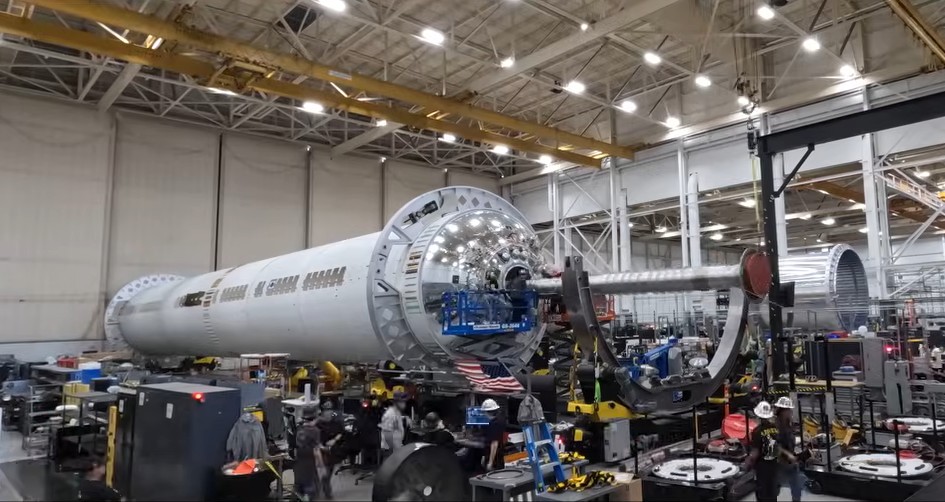 Relativity Space recently installed the “downcomer” into the first stage of the Terran R rocket. Credit: Relativity Space
Technically, this is not a medium-lift rocket. The company is advertising up to 33.5 metric tons to low-Earth orbit in fully expendable mode for Terran R. But new rockets rarely hit their advertised lift capacity early in their lifetime, and with a reusable first stage—which is necessary for the economics of Terran R to close—the lift capacity is closer to 20 metric tons.
Nevertheless, this is a large and ambitious project. And it was pretty much left for dead until former Google Chief Executive Eric Schmidt acquired the company a year and a half ago. Schmidt has injected much-needed funding into Relativity, and sources report that morale at the Long Beach, California-based company has improved significantly.
In recent months the company has reported some notable progress. It completed acceptance testing for all 13 of the Aeon R engines that will power its first stage, qualified the first stage structures, and is making progress on assembly of the first stage. Then, the company announced that the Terran R’s second stage had successfully completed its first integrated hot fire test.
Stoke and Relativity are fairly close to one another in their development timelines. Relativity is ahead in second stage testing, but Stoke has a lead in launch site readiness, giving the slight edge to the smaller rocket in terms of being ready for launch first.
Predicted launch debut: September 2027
Rocket Lab: Neutron
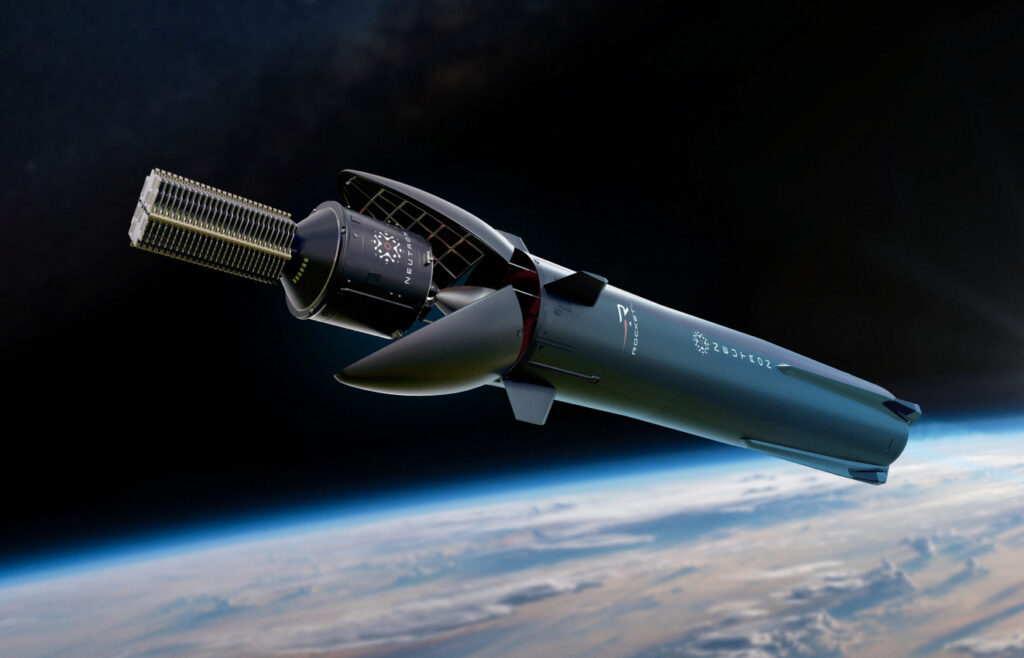 Neutron rocket concept artwork. Credit: Rocket Lab
Of all the medium-lift rockets in development, Neutron is the one backed by the most established launch company. Rocket Lab has successfully developed and operated the small Electron rocket, and that operational experience is a meaningful advantage as it scales up to a much larger vehicle.
Neutron is designed to carry up to 13 metric tons to low-Earth orbit in reusable configuration, making it a true medium-lift vehicle. The rocket is being developed at a new facility inMiddletown, Virginia, with a launch site planned at Wallops Island.
Rocket Lab has been more measured than its competitors in discussing timelines, which may itself be a sign of maturity. The company has talked about a debut in the 2028 timeframe, and given its track record of executing on Electron, that timeline deserves to be taken seriously.
Predicted launch debut: Mid-2028
Firefly Aerospace: MLV
Firefly Aerospace has already successfully launched its small Alpha rocket, making it, along with Rocket Lab, one of the few new launch companies to have actually reached orbit. That credibility matters when evaluating the prospects for its Medium Launch Vehicle.
The MLV is designed to carry approximately 16 metric tons to low-Earth orbit in expendable mode and will use a cluster of Miranda engines derived from the engine developed for Alpha. Firefly has also announced a partnership with Northrop Grumman to potentially use the MLV as part of a next-generation launch offering, which could provide a significant customer base from the outset.
However, development of the MLV is at an earlier stage than the other vehicles on this list. Firefly has not yet begun construction of a launch site for the new rocket, and the company is still primarily focused on scaling up Alpha operations and executing on its lunar lander contract with NASA.
Predicted launch debut: 2029
The medium-lift market is entering one of its most consequential periods in decades. With the Falcon 9 departing the commercial marketplace, billions of dollars in satellite contracts are effectively waiting to be claimed by whichever rockets can demonstrate reliability and production cadence. Whether any of these four vehicles can step into that role on schedule—or at all—remains the defining question for the commercial launch industry through the end of the decade.